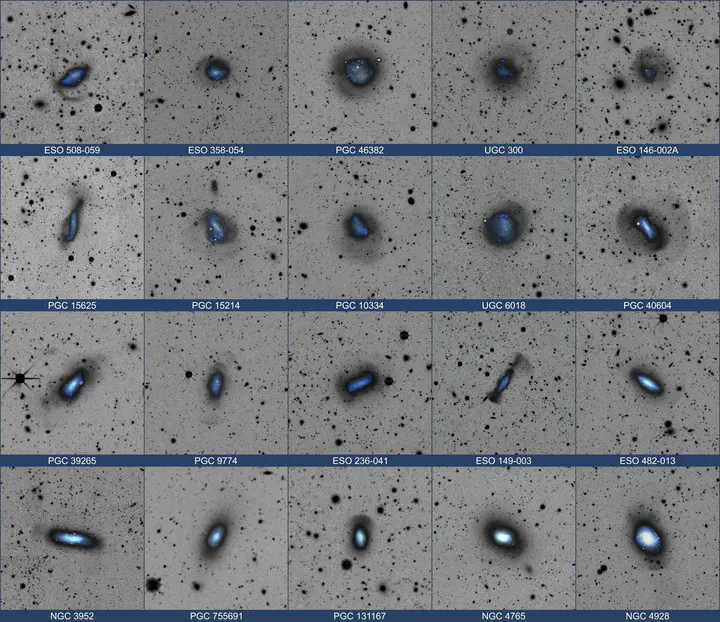
 Stellar streams around dwarf galaxies. Credit Sakowska+ 2026a, G. Donatiello
Galaxies do not grow by themselves- they ’eat’ satellite galaxies and star clusters to grow, leaving behind long trails of stars called stellar streams. Hence, stellar streams preserve the archaeological record of merger events long after the original satellite has been completely disrupted. As their shapes, properties and abundance are sensitive to the distribution and nature of dark matter, we can also use stellar streams to learn about dark matter itself.
Although we now know of 150+ extragalactic stellar streams around massive galaxies (like our Milky Way, or Andromeda), we know only a handful of streams around the smallest ‘dwarf’ galaxies. In Sakowska+ 2026a, I discovered new streams and shells around these tiny galaxies, and provided one of the first statistical estimates of their frequency in the local Universe. My results placed constraints on hierarchical mass assembly of galaxies at tiny scales, and highlighted the difficulty of finding their streams.
I am also particularly interested in studying the accretion histories of massive galaxies. In Martinez-Delgado+ 2026b we reconstructed the galaxy accretion event behind the massive shell of stars belonging to NGC 7531. Check out also Martinez-Delgado, Stein, Sakowska+ 2025, where we used amateur astrophotography to obtain ultra-deep images of spiral galaxies with streams, shedding light on never seen before features.
As part of my position at the IAA-CSIC, I am also working towards the adoption of the European Space Agency’s ARRAKIHS mission! Launching 2030, ARRAKIHS will be a space telescope dedicated to the study of the stellar halos of massive galaxies (including stellar streams) to answering key questions in galaxy evolution and cosmology.

Dr Joanna Sakowska
Astrophysicist and science communicator